
We were able to interview the elusive Bron Theron on Friday, January 9th while sitting in our car outside Aroma Cafe on Tujunga. Bron’s whereabouts during this interview (along with much about him) remain unknown. – LFDG
And we are recording. I am on the phone today with Bron Theron, the director of Fear Anonymous. It’s Wednesday January 7 2026. Hi Bron!
Bron Theron: Hi, how are you doing?
LFDG: Thank you, I’m doing very well. Let’s get started. We are promoting Fear Anonymous. Can you describe the movie to someone who doesn’t know anything about it?
BT: Sure. So, Fear Anonymous is about a group of people meeting in kind of a self-help group environment. sort of like Alcoholics Anonymous, but instead of talking about alcoholism, they talk about what they are afraid of. They have their own backstory of why they’re there. And this particular Sunday that they are all at this meeting, a new person comes to the group that nobody knows, and –it kind goes from there.
LFDG: Excellent. I know that there’s a story behind how this film came to be made, and I believe it connects to a filmmakers’ group that you are part of in Long Beach. Can you tell us more about that group and maybe the backstory of how did Fear Anonymous come to be?
BT. Sure. Boy, I don’t know how long ago this was… it was at least five or six years ago, I was in a group called the Long Beach Filmmakers Group, and they would have a meetup. That’s where I met my sound guy, that’s where I met a few other producers, a few other writers that I’ve worked on projects with. And I had an idea that we could all work on something, because I didn’t know everybody real well. I thought maybe we can all work on an anthology, and then I would work on the wraparound to put it all together, and then we would have a feature film from this group.
But a lot of people didn’t do much.
So, long story short, I eventually stopped thinking that anybody would do their story, and I just did the whole thing.
But I actually did another whole movie, two other movies before this movie. Because the beginning of this movie was actually a beginning of a different movie that I had called Half-Dead Fred. In fact, the same character in Half-Dead Fred is in this movie.
So it’s kind of like, you know, Tarantino has his own universe where he always has two cops, Nickel and Dime…Yeah, it’s kind of like that, in a weird way.
But yeah, initially it was a plan for other people to work on shorts, and then we’d all build an anthology…But I just ended up doing the whole thing myself.
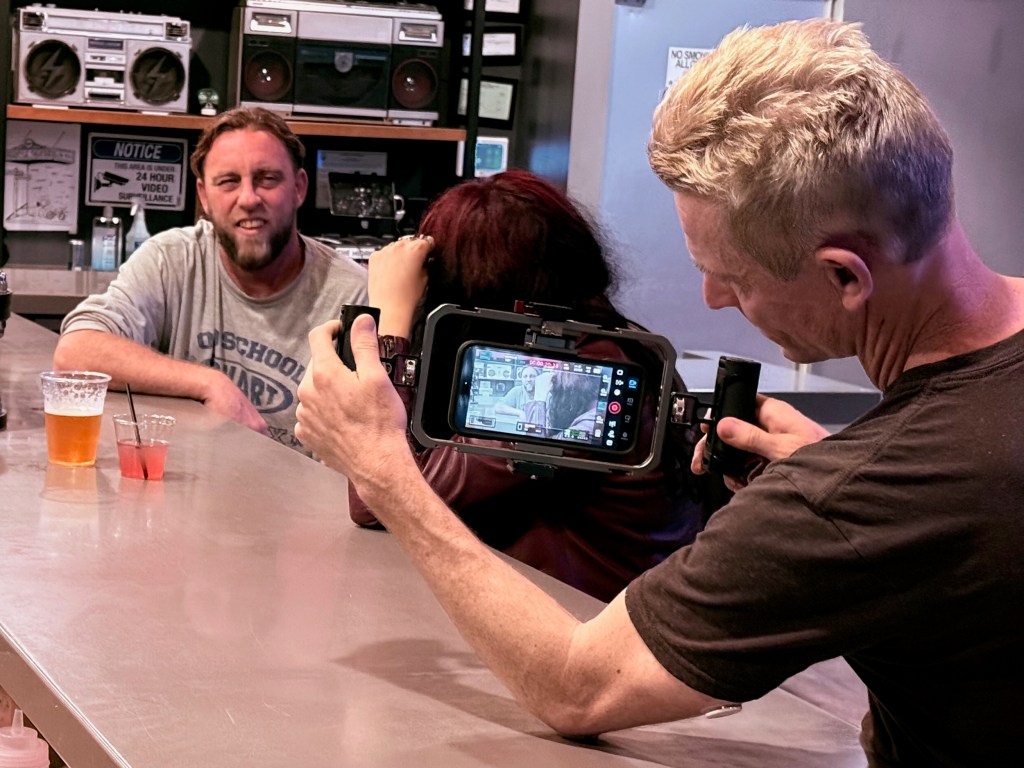
LFDG: Well, I have to say, I’m so glad that you did! But I’m curious–now that you say that so many people were involved in the beginning–did you write the script collectively with some of those other filmmakers, or was it more that they were just involved in brainstorming?
BT: No, nobody was really involved very much. I just came to a meeting one time and I said hey, I have this location, and I kind of threw out the idea of the self-help group, a therapy group. That’s the only thing that’s as far as it went as far as other people are concerned.
People liked the idea…nobody wrote anything. Nobody did anything except…
Actually, one of my buddies made a whole movie about a therapy group. So he kind of liked the idea a lot! Because he did an anthology about a therapy group too…but it’s really not anything close to mine. It’s very different. The only thing similar is that they check their phones in, there’s no phones allowed in their therapy group sessions.
LFDG: Yeah, having seen Fear Anonymous I have to say that that thread around checking the phones in definitely contributes to the tension for the audience. They’re such security blankets for us. I’m actually thinking of forcing the audience at the next screening to check their phones in too, just to be mean and to put them off guard a little bit.
BT: Nobody likes that.
LFDG: I know, it’s great! But it forces them to pay attention.
[…]
LFDG: So just to pivot a little bit, you said seven years ago you were in this filmmakers’ group, and I know from Gerard that you are also a visual artist and have been involved in street art, graffiti art, even some design and clothing design. How did you come to turn to filmmaking seven years ago? What was the inspiration behind that for you personally?
BT: Let’s see. I grew up in the Bay Area, which is like Santa Cruz, California, and i grew up painting and skateboarding. I come from a punk background—skateboarding, graffiti. And when I eventually got down here to LA, I always wanted to make movies and stuff like that, and I auditioned for a painter…through the Back Stage West actually. So back when Back Stage West was a newspaper, I auditioned, and I got this thing as a traveling painter–traveling graffiti writer–for hip-hop groups. So i went on tour with The Roots. I went on tour with LL Cool J, Busta Rhymes, De La Soul, Pharcyde, so many different groups…
For years, that job took me on the road.
And so when I was on the road, I started recording with video cameras–different graffiti in different cities–and then when I came home I started editing and made little documentaries of graffiti.
So that was kind of like my first step of being like a filmmaker, from my graffiti background. I made these things called Grafflife. And back then. to be honest, I’ve probably made the most money from any films doing those, because that’s back when DVDs would sell…so you’d make DVDs and distribute them and the markup was so great, you know what I mean? So you actually could make money back then.
But then the DVD market kind of crashed right after i made my first movie called Primal Rap which is like a mockumentary–it’s kind of like spinal tap, though with hip-hop…that was kind of like when you know when we had the 2008 crash that’s kind of uh that era. So i didn’t make any money on that one.
But it all stemmed from that touring, doing live painting for shows, from graffiti. So graffiti kind of helped my film career immensely.
LFDG: It sounds as though filmmaking as an art form has been part of your life for a long time. Is there a place where people can go and look at Primal Rap or at any of those graffiti videos or portions of them online?
BT: Yeah, you can look at it on YouTube. You can look up Primal Rap, you can look up Grafflife I, II, and III.
LFDG. Okay, I’m going to put a couple of links in here [Ed: In process] because what I’m trying to get across to the audience here is just that…part of what makes Fear Anonymous, I’m going to say pleasurable, to watch–for an audience member–is the visual sense that you have is so fully formed. Like the audience is really being taken care of visually in the film. And I would argue that comes from your background as an artist in so many different media…
[…]
LFDG: Okay. So, this is a little bit out of the blue, but what is next for you after Fear Anonymous? What are you brainstorming or thinking about? Or is this more of like a rest period for you and you haven’t chosen your next project yet?
BT: Well, I’ve got two things I’m kind of actively working on right now. I’m writing a script, and it’s a romantic comedy–it’s called One Hot Date–and I wrote 10 pages today, so I’m really early in the writing. I’m still in like Act One. But hopefully I can be done with this…soon. It just depends on me.
But I also have to do a sequel to the movie Pancake Man because we left it “to be continued,” so those two things are kind of what I’d say I want to shoot in this year.
[THE SECOND PART OF THE INTERVIEW WITH BRON THERON WILL BE POSTED AS SOON AS THE TRANSCRIPTION IS COMPLETE. THANK YOU FOR YOUR PATIENCE – LFDG]
 FEAR ANONYMOUS
Leave a comment